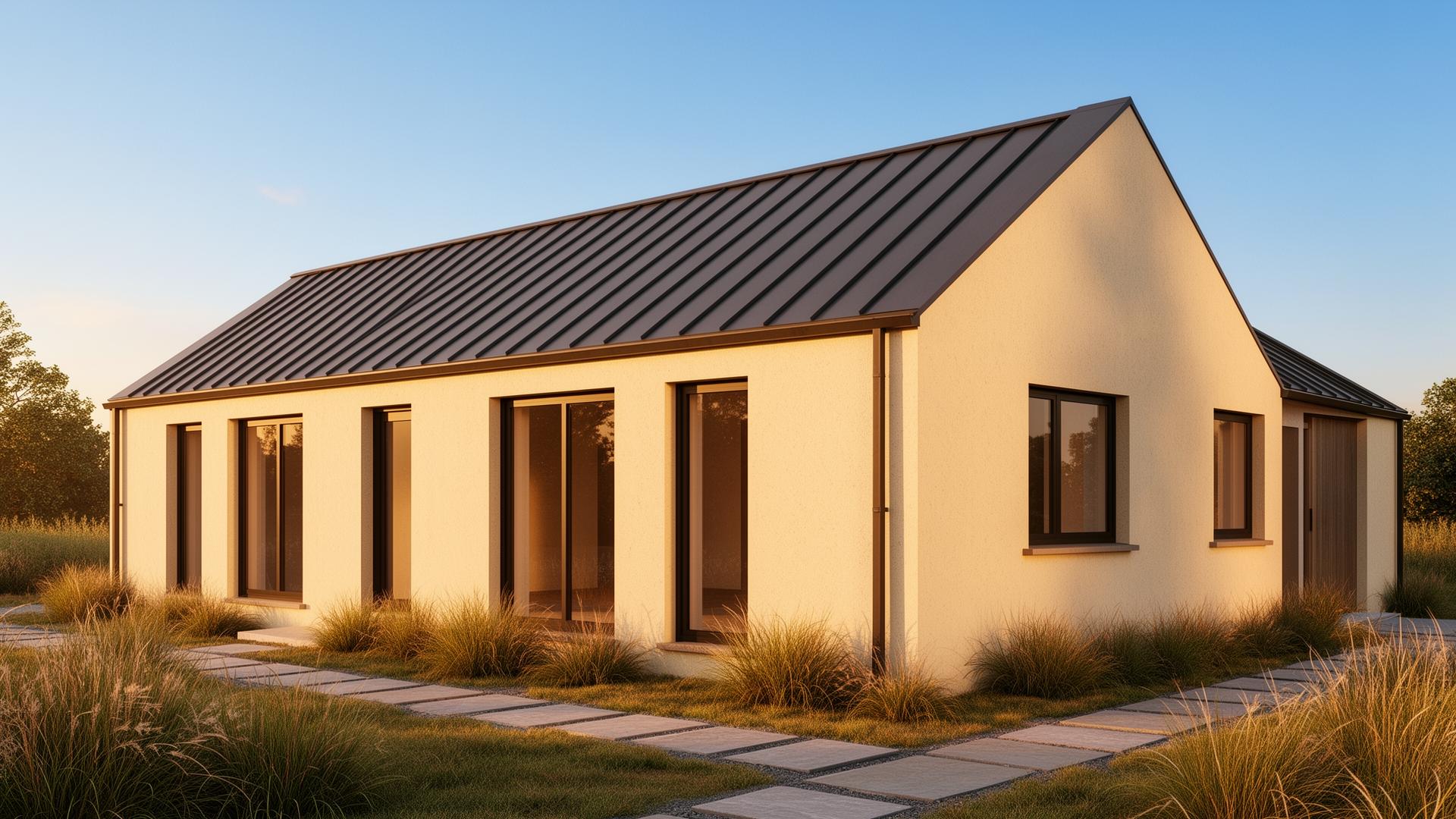
The Complete Guide to Hempcrete Blocks
A healthier, more sustainable way to build energy-efficient homes using bio-based building materials.
Discover how hempcrete blocks are changing the future of healthy home construction through carbon-storing materials, thermal performance, moisture control, and sustainable building practices.
What Are Hempcrete Blocks?
Hempcrete blocks are pre-cast bio-composite building blocks made from hemp hurd — the woody inner core of the industrial hemp stalk — bound together with a lime-based binder and water. The mixture is poured into molds, cured, and stacked on site within a structural frame to form healthy, breathable, insulating wall systems. Hempcrete blocks are one of the cornerstone materials in modern hempcrete homes and are increasingly specified by architects, builders, and homeowners who want a vapor-open, mold-resistant, carbon-storing alternative to conventional walls.
The hemp hurd provides bulk, insulating air pockets, and structural integrity to the matrix. The lime binder — typically hydraulic lime, air lime, or a proprietary mineral blend — locks the hurd in place and gives the block its compressive strength and fire resistance. Some formulations include small amounts of natural pozzolans or other mineral aggregates to fine-tune cure time, density, and long-term carbonation behavior. The result is a wall material that is part insulation, part finish substrate, and part structural enclosure — all in a single monolithic layer.
Bio-based construction is the broader category that hempcrete blocks belong to. Bio-based materials use renewable plant or animal inputs in place of petrochemical or high-embodied-carbon alternatives. Hempcrete blocks fit this definition cleanly: hemp is a fast-growing, annually renewable crop that captures atmospheric carbon as it grows, and the lime binder slowly re-absorbs CO₂ over decades through a natural process called carbonation. Over the lifetime of the building, a hempcrete block wall is typically net carbon-storing — it stores more carbon than was emitted to produce it.
Compared to conventional concrete blocks (CMU), hempcrete blocks are fundamentally different in purpose. Concrete blocks are structural masonry units made from Portland cement, sand, and aggregate; they are heavy, vapor-closed, and have essentially no insulating value. Hempcrete blocks are lightweight, vapor-open, naturally insulating, and non-structural — they rely on a wood, steel, or post-and-beam frame for gravity and lateral loads. Concrete blocks are an excellent structural component; hempcrete blocks are an excellent enclosure and indoor-air-quality component. The two solve different problems, and the comparison table later in this guide makes the trade-offs explicit.
Hempcrete blocks also differ from cast-in-place hempcrete, where a fresh hemp-lime mix is tamped into temporary formwork around a structural frame. Cast-in-place hempcrete creates a continuous monolithic wall with no joints, but requires more on-site labor, longer cure times, and tighter weather-window management. Pre-cast hempcrete blocks compress the schedule, guarantee consistent density and quality across the wall, and allow more flexible logistics for builders working in remote regions or tight urban sites. Both approaches deliver the same healthy-home benefits — the choice is a project-by-project decision driven by labor, schedule, climate, and budget.
For homeowners exploring hempcrete blocks as part of a broader healthy home design strategy, the blocks pair naturally with lime plaster, clay plaster, reclaimed wood, low-VOC finishes, ERV ventilation, and high-performance windows. They are not a stand-alone product; they are the load-bearing wall material of a complete healthy-home assembly. To see the full floor plans they support, browse our home designs library.
The remainder of this guide walks through the measurable benefits of hempcrete blocks, how they compare to concrete blocks side by side, how hempcrete block construction actually works on site, real cost ranges, the load-bearing question, the long-term healthy-home advantages, and a 20-question FAQ that covers the most common topics homeowners and builders raise during early project conversations.
Benefits of Hempcrete Blocks
Nine measurable advantages that make hempcrete blocks one of the strongest options in modern healthy home construction and sustainable building materials.
Thermal Performance
Hempcrete blocks combine continuous insulation with thermal mass. For planning purposes, use R-2.5+ per inch, recognizing that hemp-lime thermal performance varies with density, formulation, moisture content, and testing methodology. Beyond the per-inch figure, the lime-bound matrix moderates temperature swings across the day, which means lower peak heating and cooling loads and a quieter HVAC system. For healthy home construction in mixed and hot-humid climates, the assembly also keeps interior surface temperatures stable, reducing condensation risk on the inside face of the wall. Final whole-wall thermal performance depends on the complete assembly, including material density, framing, finishes, thermal bridging, moisture conditions, and installation.
Moisture Regulation
Unlike foam plastics that trap moisture, hempcrete wall blocks are vapor-open. The lime binder and hemp hurd matrix absorb and release humidity as the indoor environment changes, buffering interior relative humidity into the comfort zone (40–60%). This hygric buffering protects framing members, finishes, and occupant respiratory health. In a healthy home, vapor-open walls are one of the most consistent predictors of long-term durability and indoor air quality.
Mold Resistance
The high pH of the lime binder — typically around 12 — creates an environment hostile to mold, mildew, and many wood-decaying fungi. Combined with the moisture-buffering behavior described above, hempcrete blocks are one of the most mold-resistant building materials available for residential wall systems. This matters in any climate, but especially in coastal, humid, and flood-prone regions where conventional gypsum and fiberglass assemblies routinely fail.
Indoor Air Quality
Hempcrete blocks are mineral and plant-based with no added formaldehyde, isocyanates, flame retardants, or solvent-based binders. They do not off-gas VOCs. When paired with lime or clay plaster finishes, the entire wall system contributes to a low-VOC interior — a foundational requirement for any healthy home. Families dealing with asthma, chemical sensitivities, or post-illness recovery often report measurable improvements after moving into hempcrete homes.
Carbon Storage
Each cubic meter of hempcrete sequesters carbon two ways: the hemp plant captures atmospheric CO₂ as it grows, and the lime binder slowly re-absorbs CO₂ over decades through carbonation. Net-negative carbon performance is one of the strongest sustainability arguments for hempcrete blocks and is increasingly recognized in green building rating systems, ESG reporting, and embodied-carbon disclosure rules.
Fire Resistance
Lime-bound hempcrete walls do not burn the way wood-framed assemblies do. Independent fire testing on hempcrete wall systems has demonstrated multi-hour fire ratings without the use of halogenated flame retardants or other toxic chemistry. For wildfire-prone regions of California, Colorado, Arizona, and the Mountain West, hempcrete blocks are a credible non-toxic path to a more fire-resilient home.
Acoustic Performance
The porous, dense-but-soft structure of hempcrete absorbs and dampens sound rather than reflecting it. Interior partitions and exterior walls built from hempcrete blocks measurably reduce airborne sound transmission, traffic noise, and reverberation. The result is a quieter, calmer home that feels healthier to live in.
Durability
Hempcrete buildings in Europe have stood for decades, and lab modeling indicates a service life well beyond 100 years for properly designed assemblies. The lime binder continues to harden through carbonation over time, meaning the wall literally gets stronger as the home ages. There are no replacement cycles for foam, batt insulation, or vapor barriers because none of those layers exist.
Healthy Home Benefits
Taken together, hempcrete blocks deliver the assembly characteristics that define a true healthy home: stable humidity, clean indoor air, mold resistance, fire resilience, thermal comfort, acoustic calm, and a multi-generational service life. They are not a cosmetic upgrade — they are a structural commitment to occupant wellness.
For Contractors, Remodelers & Building Professionals
Builder, Contractor, or Entrepreneur?
Learn how Mr Hemp House® helps building professionals turn Healthy Home Assessments, retrofits, healthier materials, and new construction into a healthy-home line of business.
For contractors, builders, and remodelers. Investment required. Qualification applies.
Hempcrete Blocks vs Traditional Concrete Blocks
Side-by-side on the wall-system attributes that matter for healthy, sustainable building.
| Feature | Hempcrete Blocks | Concrete Blocks |
|---|---|---|
| R-Value | R-2.5+ per inch (planning reference) with continuous insulation and thermal mass benefit | ~R-0.1–R-0.2 per inch; needs added insulation layers |
| Carbon Impact | Net carbon-storing over the building's life | High embodied carbon from cement production |
| Moisture Control | Vapor-open; buffers humidity into the 40–60% comfort range | Vapor-closed; requires separate barriers and risks trapped moisture |
| Indoor Air Quality | No-added-VOC, mineral and plant-based materials | Often paired with VOC-emitting insulation, sealants, and finishes |
| Weight | Lightweight infill; reduces foundation and seismic loads | Heavy; structural but adds significant mass |
| Fire Performance | Multi-hour fire resistance without chemical retardants | Non-combustible but pairs with combustible assembly layers |
| Thermal Mass | Functional mass that moderates day/night temperature swings | High mass but no insulating value on its own |
| Sustainability | Renewable hemp, low-impact lime, biodegradable at end of life | Energy-intensive cement; difficult to recycle or reuse |
How Hempcrete Block Construction Works
A hempcrete block wall assembly always begins with a structural frame. Because the blocks themselves are non-load-bearing, the building's gravity and lateral loads are carried by a separate framing system — typically post-and-beam (timber or engineered lumber), light wood framing, light-gauge steel, or a hybrid combining wood posts with steel headers. The frame is detailed first, anchored to the foundation, and braced to handle wind and seismic loads independent of the hempcrete infill.
Once the frame is in place, the infill system is laid out. Hempcrete blocks are stacked between framing members using a thin lime-mortar bed at each course. Joints are kept tight to limit air leakage, and the blocks are cut as needed to fit around windows, doors, electrical chases, and plumbing penetrations. The lime mortar is chemically and mechanically compatible with the block, which means the joints behave as a single monolithic surface once cured. There are no thermal bridges through metal connectors, no foam sealants in the cavity, and no plastic vapor barriers — the entire wall is mineral and bio-based.
Lime mortars deserve a closer look. Hydraulic lime (NHL) sets faster and works well in damp climates; air lime cures more slowly through carbonation and is ideal in dry climates. The mortar is mixed thin so the block faces actually touch, leaving only a hairline joint. This preserves continuous insulation across the wall plane and keeps moisture moving freely through the assembly. The lime mortar also matches the high pH of the block, preserving the mold-resistant chemistry throughout the wall.
The next phase is exterior finishing. Hempcrete block walls are typically finished with a three-coat breathable lime render: a scratch coat that keys mechanically into the block face, a level coat that flattens the wall, and a finish coat that provides the weathered surface appearance. Lime render protects the block from driving rain while remaining vapor-open so any incidental moisture can dry to the outside. Alternatives include ventilated rainscreens of wood, fiber-cement, or stone — these are used where local code or aesthetics call for a non-plaster appearance.
The interior plaster is the other half of the system. A two-coat lime or clay plaster is applied directly to the block face on the interior side, completing the air-control layer and finishing the wall. This is one of the moments where hempcrete blocks save real money compared to conventional construction: there is no drywall, no taping, no painting, no separate insulation layer, and no vapor barrier. The plaster IS the finish, the air barrier, and a critical contributor to indoor humidity buffering.
The result is a healthy wall system built entirely from minerals and plant fiber — no foam, no fiberglass, no formaldehyde, no halogenated flame retardants, no polyethylene barriers. Combined with high-performance windows, an ERV for fresh air, and low-VOC interior finishes, hempcrete block walls form the structural backbone of a complete healthy home. For projects upgrading an existing house rather than building new, the same wall-system thinking applies — see our retrofit and renovation guide for adapted assembly details, and our healthy home materials guide for compatible finishes, plasters, and mechanical components.
On-site, a small trained crew can install several hundred square feet of hempcrete block wall per day once the frame and openings are ready. Compared to cast-in-place hempcrete, block construction is significantly faster, requires no formwork, and is far less weather-sensitive. That makes hempcrete blocks particularly attractive for builders entering the healthy-home market for the first time, for projects on a tight schedule, and for remote sites where specialized formwork logistics would be impractical.
How Much Do Hempcrete Blocks Cost?
Material costs for hempcrete blocks vary by supplier, block size, region, and order quantity, but most U.S. projects fall into a working range of $50 to $150+ per square foot of wall area for the block, mortar, and basic plaster system. Larger orders, regional production, and direct-to-builder sourcing push the number toward the lower end. Small custom projects, long shipping distances, and premium plaster finishes push it higher. For a full whole-house number including foundation, roof, mechanicals, finishes, and labor, plan on $180 to $360+ per square foot of conditioned floor area — the same range we publish on our hempcrete house cost guide.
Labor costs are the second major driver. Hempcrete block installation is not difficult, but it is unfamiliar to most general contractors and masons. Trained crews are still relatively rare in the U.S., which means markets with established hempcrete installers (Florida, Texas, North Carolina, Colorado, California, parts of the Northeast) price more efficiently than markets where a crew has to travel in. Mr Hemp House® works to develop regional installer networks specifically to compress this labor premium and bring healthy-home construction within reach of more homeowners.
Regional differences show up in three places: lime binder availability, transport distance for the blocks, and local code adoption. Regions with active lime production (the Southeast, the Mountain West, parts of the Mid-Atlantic) see lower material costs. Regions still working through code-path approvals for hempcrete may carry additional engineering, testing, and permitting fees on the first few projects in a jurisdiction. As IRC Appendix BL adoption spreads, those one-time costs are dropping.
Installation variables include wall thickness (climate-driven), opening density, ceiling height, plaster specification, and finish complexity. A 12-inch wall in a cold climate costs more than an 8-inch wall in a temperate zone. Increased wall thickness can provide greater material thermal resistance and thermal mass when appropriate for the assembly and climate, though final whole-wall performance depends on material density, framing, finishes, moisture conditions, penetrations, thermal bridging, and the complete wall assembly. A wall with many small windows costs more per square foot than a wall with a few large openings because there is more cutting, framing, and plaster detail. These are line-item conversations that happen during the design phase — not surprises during construction.
Long-term energy savings are where hempcrete blocks earn back the up-front premium. The combination of continuous insulation, thermal mass, humidity buffering, and air-tight assembly typically cuts heating and cooling loads compared to a code-minimum conventional house in the same climate. Over a 30-year mortgage, that operating-cost reduction often exceeds the wall-system premium by a wide margin — and the wall is still expected to perform for another 70+ years after the loan is paid off.
Lifecycle cost benefits extend beyond utility bills. There is no drywall to replace, no paint to refresh every five to ten years, no insulation to remove and re-install when it sags or becomes contaminated, and no vapor barrier to fail. Maintenance is largely limited to occasional re-skimming of the lime plaster, which most homeowners can do themselves. Insurance premiums in fire-prone regions are increasingly recognizing the wall system's fire-resilience profile, and resale value benefits from the documented healthy-home performance. All of these factors compound over time and shrink the true cost gap to conventional construction far more than the initial bid numbers suggest.
Are Hempcrete Blocks Load Bearing?
The short answer is no — hempcrete blocks are not designed as primary load-bearing structure. They are an enclosure and insulation material, used as infill within a separate structural system. This is consistent with how hempcrete has been deployed in Europe for the last 25 years and with how the 2024 IRC Appendix BL describes the material in U.S. code-language.
The most common structural pairing is post-and-beam construction. Heavy timber posts and beams (or engineered alternatives like glulam or PSL) carry gravity loads, while diagonal bracing or sheathing handles lateral loads. Hempcrete blocks are stacked between the posts as continuous enclosure. This approach exposes the timber on the interior for an architecturally rich finish and keeps the structural elements completely separate from the insulating envelope.
Light wood framing is the most familiar structural system to U.S. builders and works well with hempcrete blocks. Standard 2x6 or 2x8 stud walls are framed conventionally, then hempcrete blocks are installed in the bays between studs (or as an exterior overlay) to create the thermal and moisture-control layer. This hybrid approach lets builders keep their existing framing workflow while still delivering a healthy, vapor-open wall.
Light-gauge and structural steel framing is increasingly used for hempcrete barndominiums, ADUs, and commercial projects. Steel frames span large openings without intermediate posts and are highly resistant to insects and rot. Hempcrete blocks fill between the steel members and provide the insulation, mass, and acoustic dampening that bare steel cannot. See our hempcrete barndominium insulation guide for assembly details.
Hybrid construction systems combine the strengths of multiple framing approaches — for example, a concrete or ICF foundation with a wood-framed second story, or a steel exoskeleton with timber interior framing. Hempcrete blocks are agnostic to the framing choice and fit naturally into hybrid assemblies. This flexibility is one reason architects consistently return to hempcrete blocks for projects with unusual structural requirements.
Future innovations are pushing the boundaries of what hempcrete can carry structurally. Research projects in Europe and North America are exploring reinforced hempcrete blocks, pre-stressed hemp-lime panels, and hybrid hemp-bio-concrete composites that could eventually take on partial structural roles. For now, the conservative engineering answer is clear: treat hempcrete blocks as high-performance infill, design a real structural frame, and let each system do what it does best. That is also the path of least resistance through the permit office.
Healthy Home Advantages
VOC reduction is the first and most measurable healthy-home advantage of hempcrete blocks. The block itself is made from hemp hurd and mineral lime — both inert, non-off-gassing materials with no added formaldehyde, phthalates, isocyanates, or halogenated flame retardants. When paired with lime or clay plaster on both faces, the entire wall system contributes nothing to indoor VOC load. Homeowners moving from conventional houses regularly report immediate, noticeable improvements in air quality, headaches, and respiratory comfort.
Humidity control is the second advantage and is often underestimated. The hempcrete block and lime plaster matrix is hygroscopic — it absorbs water vapor when indoor humidity rises and releases it when humidity drops. This passive buffering keeps interior relative humidity in the 40–60% comfort range without mechanical dehumidification or humidification. In that range, dust mites, mold, bacteria, and many viruses are suppressed, and occupant respiratory tissue stays healthier.
Mold prevention is the third advantage and is foundational. The high pH of the lime binder is hostile to mold colonization at the wall level. Combined with the moisture buffering described above, the assembly avoids the two conditions that conventional wall systems struggle with most: stagnant moisture in cavities and warm-damp interfaces between insulation and sheathing. Mold-resistant walls translate directly to fewer asthma triggers, fewer allergy symptoms, and lower long-term remediation costs.
Improved indoor air quality is the cumulative result of those first three advantages. With no VOC source in the wall, stable humidity, and no mold pressure, the indoor air starts much cleaner than in a conventional home. Pairing the wall system with an ERV for continuous fresh-air exchange and HEPA-filtered HVAC turns the house into a measurable healthy-home environment — not just a marketing claim. Tools like our HomeHealthScan™ assessment can quantify these conditions before and after a hempcrete project.
Comfort is the lived experience of the technical benefits. Hempcrete block walls feel warm in winter and cool in summer because the thermal mass moderates surface temperatures. Floors do not feel cold. Drafts disappear. Sound from outside is dampened. The indoor temperature is consistent from corner to corner of a room. Many homeowners describe the feeling as similar to a well-built stone or adobe house — calm, quiet, and stable.
Energy efficiency is both a healthy-home and an operating-cost benefit. The continuous insulation plus thermal mass plus air-tight assembly produces dramatically lower heating and cooling loads. Smaller mechanical systems run less often, which means less recirculated air, fewer humidity swings, and less wear on equipment. Homeowners often pair hempcrete blocks with right-sized heat pumps and solar PV to push toward true net-zero operating performance.
Occupant wellness is the bottom line. Clean indoor air, stable humidity, mold resistance, fire resilience, thermal comfort, acoustic calm, and a connection to natural, non-toxic materials add up to a home environment that supports sleep, recovery, cognition, and long-term health. For families dealing with chronic respiratory issues, chemical sensitivities, post-illness recovery, or simply a desire to live in a more natural environment, hempcrete blocks are one of the most effective wall-system investments available. The HomeHealthScan™ assessment is the recommended starting point — it benchmarks the current indoor environment so the impact of a hempcrete retrofit or new build can be quantified, not just felt.
Frequently Asked Questions
Related Healthy Home Resources
Keep exploring sustainable building materials, wall systems, and healthy home design.
Hempcrete Homes
Floor plans, costs, and wall systems for healthy hempcrete houses.
ExploreHempcrete House Cost
Real-world pricing and cost-per-square-foot guide.
ExploreHempcrete Barndominium Insulation
Healthy infill for post-frame and steel barndos.
ExploreHealthy Home Design
Non-toxic architecture principles for low-VOC homes.
ExploreRetrofit & Renovation
Replace toxic materials and upgrade indoor air quality.
ExploreHomeHealthScan™
AI-powered home health assessment tool.
ExploreHome Designs
Browse Mr Hemp House® home design models.
ExploreReady to Build a Healthier Home?
Whether you're building a custom home, barndominium, ADU, workforce housing project, or retrofit renovation, Mr Hemp House® can help you explore healthier building materials and better-performing wall systems.